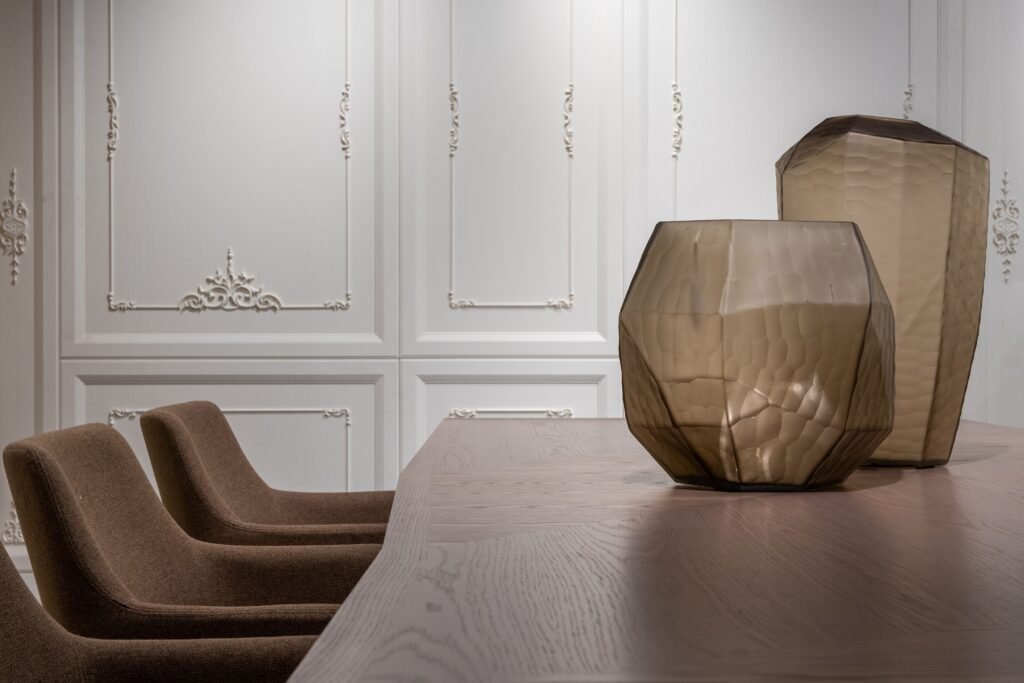
Walk into a professionally designed living room and your eye will almost always land somewhere deliberate: a fireplace, a piece of art or, very often, a single well-chosen vase. Designers reach for vases more than almost any other accessory, and not because they need somewhere to put flowers. A statement vase is one of the few objects that can organise an entire room around itself, giving the eye a place to rest and everything else a point of reference.
Here is how the professionals actually use them, and how to borrow their thinking without hiring one.
The vase as focal point, not filler
Most of us treat vases as supporting cast: something to fill a gap on a shelf or hold last week’s tulips. Designers flip that logic. They select one piece with real presence, through size, silhouette, colour or material, and let it anchor a surface the way an armchair anchors a corner.
The principle at work is simple: every room needs a visual hierarchy. When nothing dominates, the eye wanders and the space reads as cluttered, even when it’s tidy. One confident object establishes order. That’s why a designer will happily leave a console nearly bare apart from a single sculptural vase: the emptiness around it is doing half the work.
This is also why quality matters more here than almost anywhere else in the accessories budget. A focal point gets looked at, daily and up close. Investing in fewer, better objects, and looking after them properly, is a philosophy that applies across the home; there’s good advice in this guide to making classic interior pieces last, and it’s exactly how designers think about statement accessories.
Get the scale right first
The most common mistake designers see in clients’ homes is not bad taste but bad proportion. A vase that would be perfect on a dining table disappears on a large sideboard; one that suits a mantel overwhelms a bedside table.
Two working rules cover most situations. First, aim for the vase (or vase-plus-stems) to reach roughly two-thirds the height of the furniture it sits on, or of the wall space above it. Second, when in doubt, go bigger: one generous piece nearly always beats three timid ones. Grouping is fine, and designers love a cluster of three in varied heights, but the group should still read as a single visual mass.
Where to place a statement vase
Three locations do the heaviest lifting in most homes.
The console or entry table. This is the handshake of the house: the first surface a guest sees. A tall vase here sets the tone for everything beyond it, and because consoles sit against walls, you only need the piece to look perfect from the front.
The mantelpiece. Symmetry works beautifully here: a pair of matching vases bracketing a mirror is a classic for a reason. For a more current look, place one strong vase off-centre and balance it with lower objects on the opposite side.
The dining table. Here the vase must earn its keep from every angle and stay low enough for conversation, or tall and narrow enough to see past. This is where shape discipline matters most.
Why material is the multiplier
Silhouette decides whether a vase works; material decides how much. Ceramic brings warmth and matte calm. Coloured glass brings playfulness. But when designers want a piece to behave like a light fixture as well as an ornament, they specify crystal.
Cut crystal does something no other material in the accessories arsenal can: it refracts. Placed where afternoon sun or evening lamplight can reach it, a crystal vase throws small, moving flashes of light across a room; the piece becomes active rather than decorative. Its weight also gives tall arrangements the stability they need, which is a genuinely practical virtue on consoles and mantels. If you’re weighing shapes, styles and the great glassmaking houses, this guide to choosing a timeless crystal vase walks through the decisions in detail, from trumpet and cylinder forms to the cut-versus-sculptural question.
Styling through the year
A final professional habit worth stealing: designers never think of a vase as finished. In spring it holds branches of blossom; in summer, a loose garden bunch; in autumn, dried seed heads or nothing at all, because a beautiful vessel is allowed to stand empty, as sculpture. Changing what a vase holds is the cheapest room refresh there is, and it’s only possible when the vase itself is good enough to carry every season.
That, in the end, is the designer’s secret. They don’t buy vases for particular flowers or particular months. They choose one object with enough presence and quality to anchor a room for decades, and then they let the seasons revolve around it.