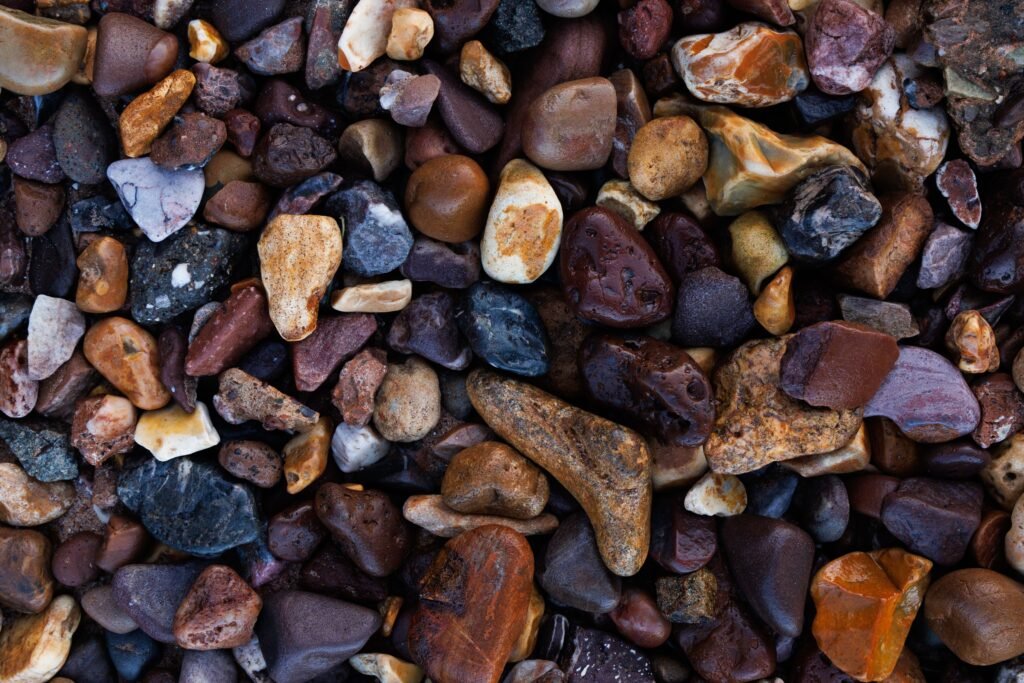
Walk into any landscape supply yard and you’ll find bins of stone in every size and color imaginable. It looks simple enough until you actually have to pick one. The stone you choose for a path behaves very differently than the stone you’d put under a fire pit or around a foundation, and picking the wrong one is a mistake you’ll be staring at for years.
That’s really the thing about decorative gravel that most first-time buyers underestimate. It’s not just about color. Texture, weight, how the stone locks together, how it feels underfoot, even how it handles a garden hose all matter. The three most popular options, pea gravel, crushed granite, and river rock, each have distinct personalities. Here’s how to figure out which one belongs in your yard.
Pea Gravel: The Smooth, Rounded All-Rounder
Pea gravel is exactly what it sounds like: small, rounded stones about the size of, well, a pea. Usually somewhere between 3/8 inch and 5/8 inch. The rounded shape comes from natural weathering in riverbeds, which is also why it’s comfortable to walk on barefoot and pleasant to sit on. If you’ve ever sunk your toes into a stone surface and it felt almost like a massage, that was probably pea gravel.
Where it works best:
- Garden paths and walkways with light to moderate foot traffic
- Play areas (it’s far more forgiving than angular stone)
- Dog runs, though more on that later
- Around plants and in beds where you want a soft, natural look
- Fire pit seating areas, since it’s comfortable and won’t hold sharp edges
Where it falls short:
Pea gravel rolls. Because the stones are round, they don’t lock together, which means they shift underfoot and travel. If you’ve ever watched gravel migrate onto your lawn or into your garage, you know the frustration. Edging is not optional with pea gravel, it’s essential. Steel, aluminum, or stone edging keeps it contained and saves you hours of raking stone back where it belongs.
It’s also a poor choice for slopes. Rain will carry it downhill and concentrate it in low spots. And it doesn’t handle heavy weight well, so it’s not the right base for a driveway or anything you’ll be driving over.
One more honest note for pet owners: pea gravel is generally dog-friendly, but some dogs do try to eat it, and the smaller sizes can be a choking concern for puppies. Most dogs ignore it entirely, but know your dog.
Crushed Granite: The Stable Workhorse
Crushed granite, sometimes sold as decomposed granite when it’s finer, is angular stone with sharp edges and flat-ish faces. That angularity is its superpower. When compacted, the pieces lock together like puzzle pieces and form a surface that’s firm, stable, and far less prone to shifting than pea gravel.
Where it works best:
- Patios and seating areas where you want furniture to sit level
- Driveways and parking pads
- High-traffic walkways
- Base material under pavers or flagstone
- Xeriscaping and modern, minimalist landscape designs
The trade-off is comfort. Crushed granite is not the stone you want under a barefoot lounge area. Those same sharp edges that make it stable make it unpleasant to walk on without shoes. It also compacts so firmly that water drains through it more slowly, which is worth thinking about if drainage is a concern in your yard.
Color-wise, crushed granite tends toward earthy tones: golds, grays, rosy pinks, and buffs depending on the quarry region. A gold or “Texas pink” decomposed granite path has a warm, sunbaked look that pairs beautifully with native plantings and ornamental grasses.
If you’re installing it yourself, the key step is compaction. Rent a plate compactor and go over it in multiple passes, with a light water spray between passes. Skip that step and your surface will stay loose and develop ruts within a season.
River Rock: The Statement Piece
River rock is the larger cousin of pea gravel, typically 1 to 3 inches across, smooth and rounded from the same water weathering. It has a completely different job. You don’t walk on river rock, and you definitely don’t try to push a wheelbarrow over it. It’s a visual element.
Where it works best:
- Dry creek beds and drainage swales (this is its signature use)
- Accent areas and borders around larger landscape features
- Around ponds, fountains, and water features
- Erosion control on slopes where smaller stone would wash away
- Filling large beds where you want a bold, chunky texture
River rock handles moving water better than almost any other stone, which is why landscapers reach for it when building dry creek beds that actually function during storms. The size and weight keep it in place where pea gravel would end up in the next county.
The downsides are weight and cost. River rock is typically the most expensive of the three per ton, and because the stones are large, coverage goes fast. It’s also a bear to move or remove later, so treat it as a long-term commitment. Weeds can be an issue too, since the large gaps between stones let light through. A quality landscape fabric underneath is close to mandatory.
Quick Comparison
| Pea Gravel | Crushed Granite | River Rock | |
| Walkability | Excellent barefoot | Firm but sharp | Poor |
| Stability | Shifts underfoot | Locks when compacted | Stays put by weight |
| Best for | Paths, play areas, fire pits | Patios, driveways, walkways | Drainage, accents, dry creeks |
| Slopes | Avoid | Good with compaction | Excellent |
| Relative cost | Low to mid | Mid | Highest |
| Edging needed | Always | Recommended | Helpful |
Download CSV
A Few Buying Tips Before You Order
First, always order more than your math says you need. Stone settles, spreads, and disappears into the soil over time. Adding 10 to 15 percent to your estimate is the standard advice for good reason.
Second, buy by the ton or cubic yard from a landscape supply yard, not by the bag from a big box store. Bagged stone can cost three to four times as much, and the quality is inconsistent. If your project is bigger than a few bags’ worth, go bulk.
Third, think about depth. For paths and patios, you want roughly 2 to 3 inches of stone over a compacted base. For areas with weed pressure, lay landscape fabric first. It won’t stop weeds forever, but it cuts them down dramatically and keeps your stone from sinking into the dirt.
Fourth, consider mixing. There’s no rule saying one stone must do everything. A common and very effective combination is crushed granite for the main walking surfaces with river rock accents along the edges or in drainage channels. You get stability where you need it and visual interest where you want it.
The Bottom Line
If you remember nothing else, remember this: match the stone to the job, not just the look. Pea gravel for comfort and casual paths, crushed granite for firmness and function, river rock for water, slopes, and drama. Visit a local supplier and look at the stone in person too. Photos online never quite capture the color, and the same stone name can look completely different depending on which quarry it came from.
A little homework up front means a surface you’ll enjoy for a decade or more, instead of one you’re quietly fixing every spring.