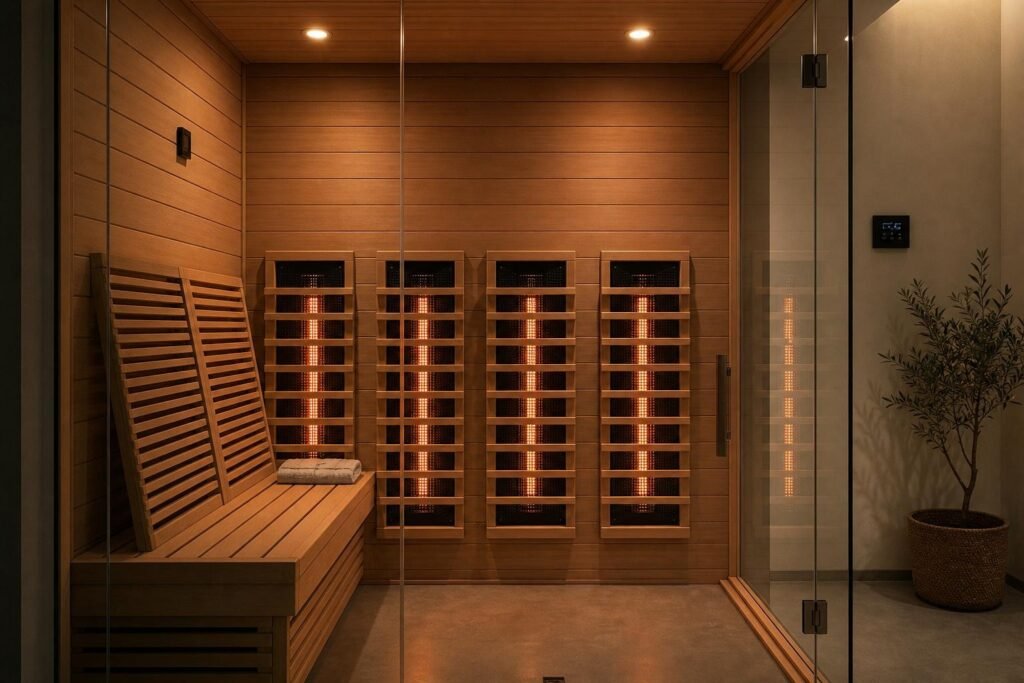
As a custom space integrator and luxury wellness builder since 2014, we’ve noticed a painful, recurring trend at Residence Style: a homeowner spends $30,000 on custom vertical-grain Canadian red cedar, only to install a low-grade infrared sauna heater setup. The finished room looks stunning, but reliance on convective air heating causes discomfort, unlike the deep radiation of medical-grade IR. You end up hot, stuffy, and uncomfortable because the elements are heating the air rather than your body.
If you’re building a high-end wellness space, you shouldn’t fall for flashy marketing terms like “tri-light fusion” or “triple-therapy spectrum.” To measure therapeutic efficacy, evaluate radiant intensity and peak emission based on the 7-10 micron therapeutic optimum.
Key takeaways
- The ultimate biological target for far-infrared therapy is a peak wavelength between 7 and 10 microns, matching our skin’s natural absorption threshold.
- The Inverse Square Law dictates that dropping your distance from an emitter by half—from 12 inches to 6 inches—increases the radiant intensity hitting your body by exactly 4x.
- Safe, long-term residential therapy should run with continuous seated magnetic fields under 0.20 mG, well below the World Health Organization continuous exposure guideline of 3 mG.
The Science of Sauna Efficacy: Beyond the Hot Air
Optimizing infrared sauna design requires matching light output to specific human biological absorption thresholds. Thermodynamic calculations allow you to audit manufacturer performance claims without relying on marketing materials.
Wien’s Law of Displacement: calculating peak wavelength
To find out what kind of light a heater actually emits, we have to look to Wien’s Law of Displacement. This fundamental physics equation states that the temperature of a physical element dictates its peak spectral output. The simple calculation is:
Peak Wavelength (microns) = 5268 / (heater surface temperature in °F + 460)
If a manufacturer won’t tell you the surface operating temperature of their heating elements, you shouldn’t buy them. If you do know the temperature, this formula tells you if the heater is actually capable of emitting therapeutic wavelengths, or if it’s simply running too hot or too cold to be useful.
The human tissue threshold: why 7 to 10 microns matters
Our skin has a natural peak emission and absorption threshold of roughly 9.5 microns. Because of this, the biological sweet spot for far-infrared light ranges from 7 to 10 microns. When light hits this window, your body absorbs the energy deeply rather than reflecting it away.
This reveals a major paradox in heater design: cranking up a heater’s operating temperature to extreme levels actually degrades its therapeutic value. As the element gets hotter, the peak wavelength shifts downward, moving right out of the biological absorption window. You might feel a blistering heat on your skin, but the light is no longer penetrating your muscle tissues.
Comparing Heater Architectures: Carbon vs. Ceramic vs. Halogen
Selecting the physical material of your heating elements determines how energy is transferred to your body. Every material operates within a distinct thermal range, directly affecting your comfort, sweat class, and overall safety.
Different materials dictate how your body receives heat, making it important to understand the trade-offs between surface temperature and radiant intensity.
Carbon panels: massive surface area with low therapeutic output
Standard carbon panels operate at highly comfortable, lower surface temperatures, typically between 140°F and 150°F. Thanks to Wien’s Law, we know this yields a gentle peak wavelength of 9 to 11 microns, which aligns quite well with the upper end of the human absorption window.
However, carbon panels have a clear limitation: because they run cool, they have a low radiant output. While carbon panels benefit from large surface area and low EMF output, their 140-150°F operating temperature necessitates longer durations for core temperature elevation. Carbon emitters rely on convective air warming, as their 0.94-0.95 emissivity and 140-150°F range provide insufficient radiant intensity for rapid core heating.
Matching your sauna’s output to the 7-10 micron biological window ensures the heat penetrates your body rather than just warming the air around you.
Ceramic elements: high radiant emissivity with severe comfort limitations
Though they are a key point of comparison when looking at infrared vs traditional saunas, traditional ceramic elements represent the opposite end of the engineering spectrum. They boast an exceptional emissivity rating of 0.99, meaning they convert electricity into radiant heat with incredible efficiency, but they run blistering hot—often between 350°F and 400°F.
At this high range, their peak output shifts down to 6 to 7 microns, which sits at the very edge of human skin absorption. While you get raw energy, the user experience is notoriously harsh. Ceramic elements generate intense localized hot spots, meaning you’ll likely spend your session shifting around or cutting your treatment short because your skin feels like it’s burning.
Halogen bulbs: the misleading ‘full spectrum’ marketing play
You’ll often see halogen heaters marketed as premium “full spectrum” or “near-infrared” wellness upgrades. However, as any detailed infrared sauna heater comparison reveals, these systems run at extreme temperatures of 750°F or higher, throwing off a short peak wavelength of roughly 4.4 microns.
It’s crucial to understand that these wall-mounted, high-heat bulbs are biologically distinct from the focused near-infrared LEDs (660 to 850 nm) used in clinical, close-skin photobiomodulation research. High-temperature halogen bulbs primarily heat your outermost skin layer, creating a heavy, sweat-inducing thermal load without the deep, gentle radiant penetration of a true clinical light source.
VantaWave® engineering: balancing thermodynamics and comfort
To solve the compromises of standard carbon and ceramic, advanced systems like VantaWave® heaters are engineered to run at a calibrated surface temperature of 190°F. This precise temperature produces a peak wavelength of exactly 7.9 microns—the center of our natural absorption window.
With an emissivity rating of 0.97, these specialized elements provide deep, penetrative heating without the harsh hotspots of ceramic. They use advanced systems like the CORE 5™ power supply to handle temperature regulation, actively managing current flow to ensure the panels stay locked exactly in their targeted therapeutic band during your entire session.
Spatial Thermodynamics: Why Panel Placement Determines Your Radiant Dose
While choosing a home sauna location is the first key step, even the best-engineered heaters will fail to deliver results if they are poorly positioned inside your cabin. The spatial layout of your setup dictates precisely how much radiant energy actually hits your body.
Moving just a few inches closer to your heater significantly boosts the radiant dosage you receive due to the physics of light intensity.
The Inverse Square Law: distance holds the pen on dosage
The physics of radiant intensity is entirely proximity-dependent. The Inverse Square Law states that the density of light energy dropping onto a surface is inversely proportional to the square of its distance from the source.
You should treat your sauna build like an engineering project by verifying performance data before you commit to a specific heating setup.
In everyday terms: if you halve your distance from the emitter—moving from 12 inches away to 6 inches away—you don’t just feel a little warmer. The radiant intensity of the therapeutic photons hitting your skin increases by 4x. This is why expansive, decorative cabins with sparse heaters placed far from the seating area are highly inefficient; the light simply loses its therapeutic power before it ever reaches you.
Atlas™ placement architecture: achieving true 360-degree coverage
To solve the distance challenge, sophisticated custom builds utilize the Atlas™ Placement Architecture. Instead of leaving massive visual blank spots on wooden walls, this layout arranges heating panels strategically around the natural seated position.
By placing heaters behind the back, flanking the side walls, under the bench for the calf muscles, and on the front wall or door, you get complete 360-degree coverage. This enveloping footprint keeps your body highly close to the emitters, ensuring you receive an optimal, uniform dose of light from every angle.
Electromagnetic Fields: Safety in Cumulative Exposure
Sauna designs should prioritize minimizing electromagnetic interference to ensure session safety.
Testing for electromagnetic fields at the seat is essential because it guarantees your sauna remains a place for recovery rather than an unnecessary source of stress.
The health threshold: comparing home standards to WHO guidelines
The World Health Organization (WHO) outlines a continuous magnetic exposure threshold of 3 milligauss (mG) for safety. While standard household appliances briefly exceed this, sauna bathing is a highly intimate, prolonged, and repetitive form of close-contact exposure.
Cheap, unshielded import heaters often register anywhere from 20 to 100 mG directly on contact. Over decades of regular usage, sitting inches away from these unshielded currents can compromise the relaxing, low-stress environment you want to build at home.
Real-world metrics: measuring under full thermodynamic load
Many manufacturers exploit testing loopholes to claim low-EMF performance. They might test their panels from several feet away, or measure them during low-power heat phases before the heaters are running at full, continuous capacity.
For authentic safety, EMF mitigation must be measured at the actual seated position where your back rests, under full operating load. Premium engineered cabins leverage robust dual-conductor shielding to suppress electrical and magnetic signatures, bringing the active fields down to an incredibly safe level of under 0.20 mG at the seat.
How to Choose an Infrared Sauna Heater: Verifying Real-World Performance
If you’re evaluating layouts and sourcing heaters for a custom design, you need a reliable roadmap to bypass the common traps found in high-end showrooms.
Sauna Evaluation Checklist:
[ ] Surface Temp Check: Calculate Peak Wavelength using Wien’s Law.
[ ] Emissivity Verification: Request rated value (look for 0.95 to 0.99).
[ ] Seated EMF Report: Insist on third-party test data (0.20 mG at the seat).
[ ] Layout Blueprint: Look for 360-degree coverage (back, sides, calves, front).
The thermometer myth: convective dial gauges vs. radiant output
The most common diagnostic error builders make is relying on a standard wall-mounted dial thermometer. These mechanical instruments measure convective air temperature, not the radiative load absorbed by your skin.
If you build a room that raises air temperatures via convection, your dial thermometer will register high but radiant tissue penetration remains minimal. However, you’ll feel uncomfortable, stuffy, and overheated from the hot ambient air without receiving any deep light penetration. True infrared sweat is triggered inside your core, not by suffocating convective heat.
Engineering checklist: how to identify commercial quality
When looking at saunas or DIY heater panels for sale, act like an engineer rather than a consumer. Use these key vetting questions before you buy:
- What is the surface temperature under load? Use it to calculate the peak wavelength. It should hit between 7 and 10 microns.
- Can you provide third-party, seated-position EMF reports? Ensure the levels stay well below the 3 mG WHO guidelines.
- Do the panels run on standard home lines? Verify if you need a high-power dedicated line or standard 120v integration.
- What is the certified emissivity rating? Ensure it matches the performance standards of high-end, commercial-grade systems.
Prioritizing thermodynamic efficiency over cabinet aesthetics ensures clinical-grade recovery.
Frequently Asked Questions
What are the downsides of infrared saunas?
The primary drawback is the reliance on convective air heating in low-grade units, which leads to a stuffy, uncomfortable experience rather than deep tissue stimulation. Additionally, many systems suffer from poor engineering that results in harsh hot spots, high electromagnetic fields, or light outputs that fall outside the body’s natural 7-10 micron absorption threshold.
What is the difference between carbon and ceramic infrared heaters?
Carbon panels operate at lower surface temperatures, providing a gentle experience but often lacking the radiant intensity needed for rapid core heating. In contrast, ceramic elements run at very high temperatures, which creates intense radiant energy but can cause skin discomfort and force you to cut sessions short due to harsh, localized heat.
How does the Inverse Square Law affect my sauna session?
This law states that as you move closer to a heat source, the intensity of the light energy increases by the square of the distance. Practically, this means moving just a few inches closer to an emitter provides a significantly higher dose of therapeutic radiation, making the layout and positioning of panels critical to effectiveness.
Why does the temperature of a heater change its therapeutic value?
According to Wien’s Law of Displacement, the surface temperature of an element dictates its peak wavelength. If a heater runs too hot, the peak wavelength shifts downward and exits the 7-10 micron range, which is the only band your body can deeply absorb; essentially, hotter is not better.
How much magnetic field exposure is considered safe in a sauna?
While the World Health Organization sets a safety threshold for continuous exposure at 3 milligauss (mG), high-quality saunas should aim for levels well below 0.20 mG. Because sauna sessions involve prolonged, close-contact exposure, minimizing these fields is essential for long-term health.
Can I trust the thermometer in my infrared sauna?
Most standard dial thermometers measure air temperature via convection rather than the actual radiant load reaching your skin. Relying on these will only tell you how ‘stuffy’ the room is, and they fail to reflect whether your body is actually absorbing the therapeutic infrared light required for deep heating.