Super glue has a reputation for sticking anything to anything, including fingers. That reputation is half earned. It’s brilliant on some materials and close to useless on others, and the difference explains most failed repairs.
Knowing what it can and can’t do before you start saves time, frustration and a few ruined items.
How Super Glue Actually Works
Super glue is a cyanoacrylate adhesive. It cures when it reacts with tiny amounts of moisture on the surfaces being joined, which is why it sets so quickly. A thin layer cures fast and strong. A thick layer cures slowly and weakly, because the moisture can’t reach through it.
That’s why less is better. Gorilla recommends a single drop per 6.5 square centimetres for its Super Glue, noting that excess glue can delay or ruin the bond.
It also explains why super glue loves close-fitting parts. When two clean edges meet tightly, the glue spreads into a thin film and cures almost instantly. When there’s a gap, the glue pools, cures slowly and forms a brittle lump that snaps under light pressure.
What Super Glue Fixes Well
Most hard plastics, metals, wood, ceramics, paper and rubber bond well with a good super glue. An impact-resistant super glue such as Gorilla Super Glue is formulated to handle bumps and drops, which suits items that get handled often.
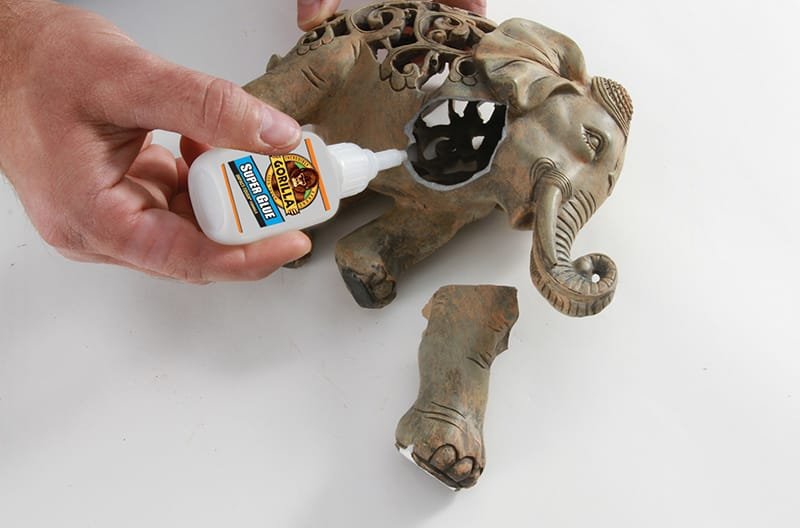
Around the house, that covers a long list. Ceramic ornaments, plastic toys, loose knobs and handles, picture frame corners, shoe trims, broken clips, jewellery, model kits and small decorative items. The common thread is a small contact area with clean edges that fit closely.
It’s also good for quick fixes where clamping is awkward. Holding two pieces for 10 to 45 seconds beats rigging up clamps on an oddly shaped ornament.
Gel versions add another option. A gel super glue doesn’t run, so it suits vertical surfaces, porous materials like wood and fabric trims, and repairs where a runny liquid would drip away before it sets.
What It Struggles With
Some plastics resist almost every adhesive. Polyethylene and polypropylene, found in food containers, buckets, garden furniture and many bottle caps, have a slippery, low-energy surface that super glue can’t grip. Check the recycling code: 2, 4 and 5 are the ones to watch.
Glass is another weak spot. Gorilla notes that glass won’t form a good bond with its Super Glue, so a broken drinking glass or window pane needs a different approach, and usually a replacement.
Gaps are a problem too. Super glue needs close contact. If the broken edges don’t meet, or a chunk is missing, the glue has nothing to bridge with. A gel formula handles small gaps slightly better, while epoxy or a gap-filling adhesive handles bigger ones.
Flexible items are hit and miss. Super glue cures hard, so it can crack on things that bend repeatedly, like a phone case, a strap or a soft plastic toy. For items that flex in use, a flexible adhesive usually lasts longer.
Where It Shouldn’t Be Used
Water is the big limit. Gorilla Super Glue isn’t waterproof and is recommended mainly for indoor use. Outdoor furniture, garden fixtures, shower fittings and anything that sits in water need a waterproof adhesive instead.
Food contact is off the table. Cups, plates, cutting boards and storage containers that touch food shouldn’t be repaired with super glue, and Gorilla advises against storing it near food or in the fridge.
Load-bearing repairs need more than a thin glue line. A chair leg, a shelf bracket or a ladder rung needs proper joinery, wood glue or mechanical fixings. And aquariums are out entirely, as Gorilla doesn’t recommend its Super Glue near aquatic life.
Heat matters less than people think for indoor items. Once cured, Gorilla Super Glue holds between -53°C and 104°C. Water and constant moisture are much bigger threats than temperature for most household repairs.
Getting the Best Result When It Does Fit
Clean and dry both surfaces. Lightly sand smooth surfaces like glossy plastic or metal to give the glue a better key. Dry fit the parts so you know exactly how they meet.
Apply one small drop, press firmly and hold. Then leave it. Gorilla advises a full 24 hours for complete cure, even though the bond feels solid in seconds.
If you get glue on your skin, don’t pull. Soak the area in warm, soapy water and gently work it apart. Acetone-based nail polish remover also helps, followed by moisturiser.
Use super glue for what it’s good at, which is small, precise, indoor fixes, and it earns its place in the kitchen drawer.